NCP Secure Enterprise Solution -
One Console. One Policy. One Pipeline. Every OS. Fully Managed
NCP Enterprise VPN suite is a highly secure manageable VPN remote access solution that allows IT teams to configure, deploy, and monitor the NCP Secure Enterprise VPN clients across Windows, macOS, and Linux from a single management console.
Feature-rich, it unifies SD-WAN, SASE, SSE, and Zero Trust capabilities into one centrally manageable solution for high-compliance environments. Modular in design, it comprises a centrally managed infrastructure for management and monitoring, a secure gateway (with an option for a virtual appliance), and clients.




How NCP Enterprise VPN works
Incredibly fast, scalable, and flexible, requiring only one click from the user. On the back end, NCP enforces endpoint compliance, applies the correct policy profile, and establishes an encrypted tunnel before granting access. Low friction, high speed, and ideal for installation in enterprise environments.
NCP Secure Enterprise Client establishes connectivity between devices and networks with one click. Security and connection policies are defined centrally and applied to the endpoint.
NCP Secure Enterprise VPN Server (SES/vSES) serves as the central gateway for incoming VPN connections. It authenticates users and endpoints, negotiates and terminates the encrypted tunnels, and enforces policy on what each session can reach on the internal network.
NCP Secure Enterprise Management (SEM) is the single point of administration that manages end users, devices, and VPN clients from one place. It imports identities from directory systems like Active Directory, automates client rollout, certificates, and licenses, and checks security policy compliance, with a built-in RADIUS server and two-factor authentication.
These three products work synergistically together to create a centrally managed remote access solution that provides security, flexibility, and scalability to your network.
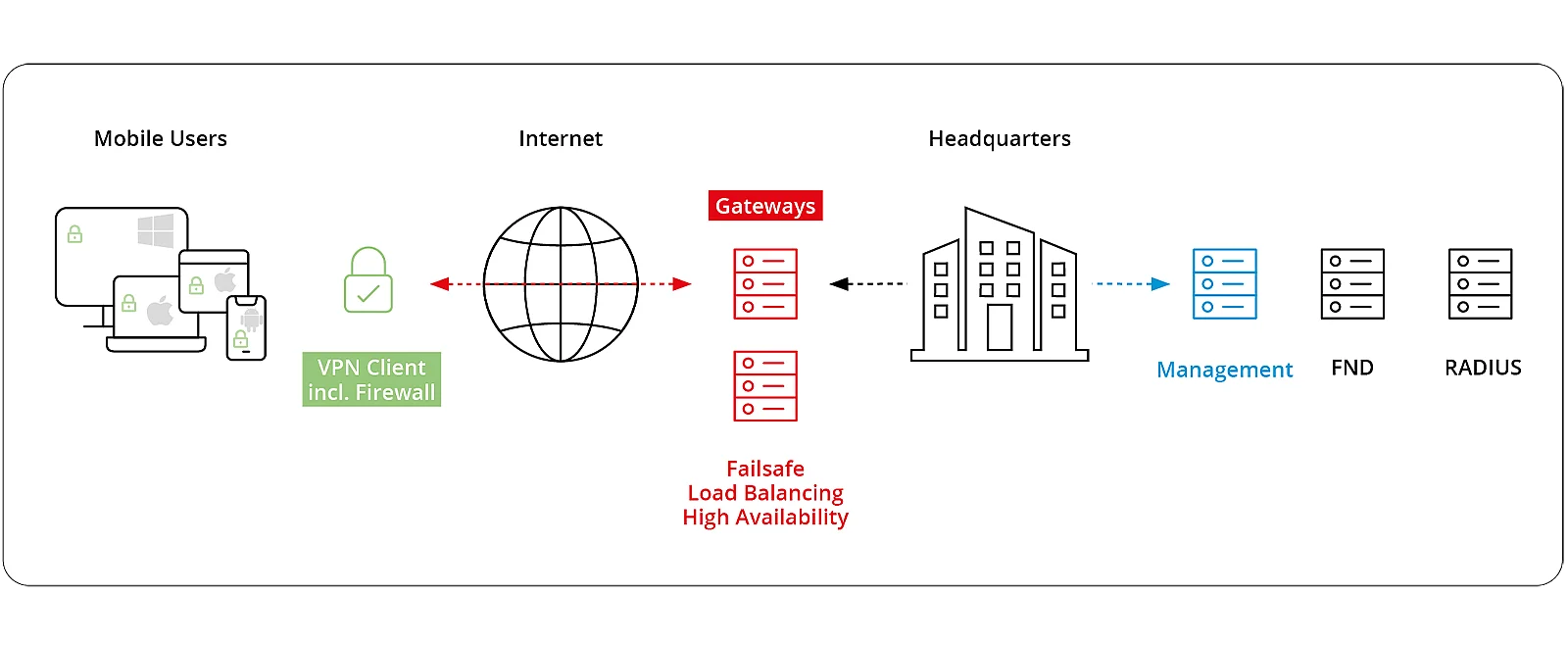

NCP Secure Enterprise Use Case
NCP Enterprise VPN in Production: Real Deployments, Real Scale
The Federal Employment Agency, one of Europe's largest public-sector IT operations, needed to replace aging dial-in infrastructure with a modern, internet-based VPN solution that could scale to meet the demands of a large, distributed workforce. The agency required secure, provider-independent access across a wide range of connection types, including mobile networks, while ensuring employees could reach mission-critical enterprise applications from any remote location, not just basic email and productivity tools.
NCP engineering was selected through a formal competitive procurement to deliver a fully managed IPsec VPN platform. The NCP VPN Client Suite, paired with the NCP Secure Enterprise VPN Server and centralized Secure Enterprise Management (SEM), gives employees one-click secure connectivity over any network while allowing IT to enforce tamper-proof security policies across every endpoint from a single console. Since rollout, the platform has delivered high stability, strong user adoption, and the scalability to match evolving workforce demands.
150,000
VPN Client licenses deployed
1,800
Connected properties and locations
11,400
Infrastructure Servers
FAQ's
Here you'll find concise information on the deployment, integration, and centralized management Enterprise VPN from NCP.
Yes. The client supports certificate-based authentication (X.509 v3), one-time passwords, and biometric authentication such as fingerprint or face recognition on supported Windows hardware, with the connection only established once authentication completes. For certificate storage, it supports PKCS#11 for hardware tokens and smart cards and PKCS#12 for soft certificates, along with RSA SecurID compatibility. Multi-certificate support also lets one device hold and apply separate certificates for different connection profiles, useful for users who need distinct credentials for different parts of the organization.
Yes, this is a core client feature. The client provides Secure Hotspot Logon and seamless roaming, along with a personal firewall and endpoint protection, so users can authenticate through captive portals and switch networks while the VPN session and security posture stay intact.
Yes, through the VPN Bypass function. Administrators can define specific applications, domains, or target addresses that are allowed to route directly over the internet even when split tunneling is otherwise disabled. This is typically used for high-bandwidth traffic like video streaming, so it doesn't consume tunnel capacity or burden the gateway unnecessarily, while the rest of the user's traffic stays protected.
The client's VPN Path Finder Technology handles this automatically. If the standard IPsec port is blocked, the client falls back to an IPsec-over-HTTPS mode using port 443, which is rarely blocked by public or corporate firewalls. The switch happens without user intervention, so remote workers connecting from hotels, client sites, or other restrictive networks stay connected.
The client surfaces its own state directly. Every NCP Secure Client displays its connection and security status independently of the operating system, with cursor-sensitive tooltips that provide plain-language status information. The connection process can be automated with a clear visual indicator at each stage. That gives both the end user and support staff a quick, unambiguous read on whether the tunnel is healthy without digging into logs.