NCP Secure Enterprise Management - One Console. The brain behind it all.
The NCP Secure Enterprise Management (SEM) provides a full central management of your entire remote access VPN network. Built as a single console that automates client rollout across Windows, macOS, Linux, iOS, and Android, along with NCP’s Secure Enterprise VPN Server.
Configures updates, enables certificate and license management, and ensures security policy compliance like Network Access Control. NCP Secure Enterprise Management synchronizes identities with LDAP/Active Directory (AD) and Identity and Access Management (IAM) systems. It also includes a built-in RADIUS server and supports two-factor authentication via SMS OTPs and offline TOTPs generated by the NCP Authenticator App.

Administration – Centralized Control for Simplified VPN Management
Automates administrative tasks and manages users and devices at scale. Enforces network access control (NAC) and compliance policies, reducing the need for manual verification. Applies consistent access policies across remote endpoints, reducing manual maintenance and ensuring users and devices are properly provisioned.
Helps maintain the NCP Secure Enterprise Clients and policies across the environment, reducing the need for manual intervention for certificate and credential administration. The system provides intelligent multi-tenancy support allowing dedicated administrator groups and organization-level access rights. It also interfaces with SIEM systems to integrate remote access information into broader security monitoring.
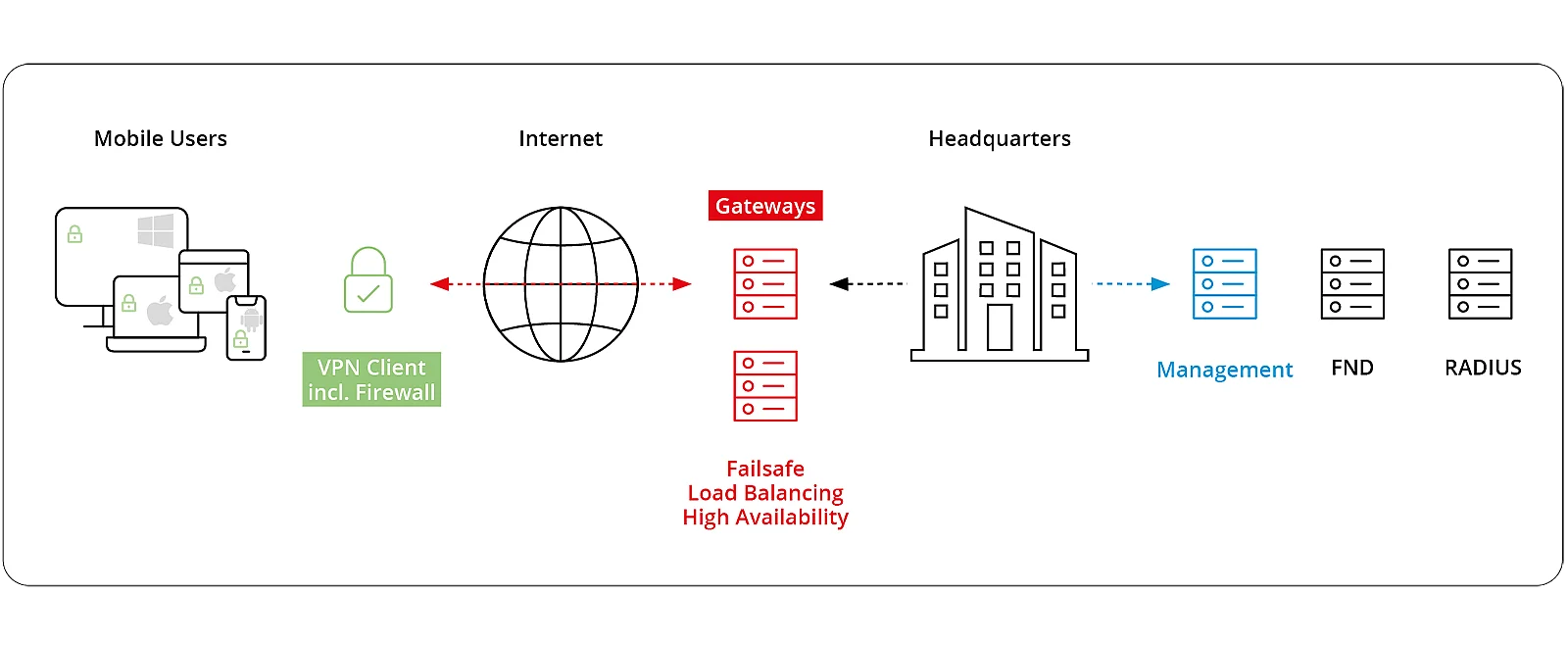
Deployment – Faster, Simplified
Centralized rollout lets IT teams establish standardized configurations and policies, then propagate them across the remote-access environment. NCP’s SEM features template-based generation of group-specific and connectivity parameters, centralized configuration updates, logging of versions and configuration changes, and automatic provisioning.
Deploys in hours, not weeks. With one console for the whole rollout. Requires minimal management effort with fewer help-desk calls. No painful initial setup or configuration complexity. No fragmentation. No multi-consoles.
NCP’s Secure Remote Access Features
Identity & lifecycle automation
- Direct sync with Active Directory / Microsoft Entra ID
- Eliminates the classic “ex-employee still has VPN access”
Authentication & PKI
- Integrated two-factor authentication (TOTP)
- Built-in PKI Enrollment plug-in acting as a Registration Authority
- Certificate revocation handling (CRL/ARL) plus OCSP online checking
Multi-tenancy
- Multi-group support with isolated admin scopes
- Connect global departments and offices
Network Access Control/endpoint posture
- Pre-connect posture checks
- Non-compliant devices get shunted to a quarantine zone
- Granular, per-application access grading for SSL VPN based on posture/security level
Auditability & operations
- Central dashboard for status/logs
- Detailed statistics, logging, and SYSLOG export
- License pooling with automatic reclaim/reissue
Resilience
- Optional Backup Management Server with integrated replication for High Availability
- Failsafe and Load Balancing options
FAQ's
Answers to common questions about deploying, integrating, and centrally managing NCP Secure Enterprise Clients
Yes. NCP Secure Enterprise Management is built to integrate into any existing IT environment rather than requiring a separate, siloed system. It connects to established directory services such as LDAP and Active Directory, as well as identity and access management (IAM) systems, so user and device data sync directly from infrastructure you already have in place. It also includes an integrated RADIUS server and interfaces to SIEM tools, allowing it to plug into existing authentication and security-monitoring workflows rather than replacing them.
Because user and device provisioning, configuration updates, and certificate management are fully automated from a single console, IT staff spend less time on manual setup and troubleshooting — resulting in fewer support tickets reaching the help desk. The system's integration with existing directory services (LDAP, Active Directory) also means end users don't need to learn a new login or access process, reducing training needs. And because configuration and rollout are centrally managed rather than handled device by device, there's less need for extensive internal documentation to guide manual processes.
NCP Secure Enterprise Management provides a single point of administration for the remote access environment, allowing administrators to centrally manage users, endpoint devices, configurations, certificates, licenses, and security policies. Users or devices can be added or have permissions revoked centrally.
NCP's Endpoint Security/Network Access Control capabilities check security-relevant parameters on endpoints against centrally defined policies. Depending on the configured rules, endpoints can be allowed or denied access, helping ensure that devices meet required security conditions before connecting.
Yes. NCP provides standardized interfaces for LDAP, Active Directory, and identity and access management (IAM) systems, enabling automated identity management for remote-access users. It also includes a RADIUS server and supports two-factor authentication with one-time passwords.